
Davidson, Explained
X, Explained | I


I. Introduction
When people write about the philosophy of language (even just philosophy in general) outside of academic spaces, for whatever reason there seems to be a clear absence of Donald Davidson. Everyone loves to talk about Russell and Wittgenstein, and maybe to some extent people like Frege. All of the aforementioned philosophers deserved to be talked about thoroughly, since they have all contributed substantially to the field, but 1) There’s a general lack of the nitty-gritty details that substantiate philosophical inquiry in general readers; and 2) A certain strand of the field in public philosophical consciousness seems to have been lost to discussions about private languages, speech-acts, and reference. This strand is Davidson’s, and I don’t believe an accurate history of the philosophy of language can be told without Davidson’s contributions. Why this absence seems to have occurred I do not know, and I will not attempt to answer that here.
Instead, I want this to be the start of a series where I simply give high-level summaries of and some original commentary on the thought of philosophers that personally interest me. They may be an integral part of my current research, or simply figures that piqued my interest. In this case, Davidson is integral to my thesis topic, so I’m excited about him generally, and I find him one of the most fascinating philosophers ever to have been produced by the analytic tradition. I won’t necessarily post these back-to-back (though I may), but I’ll try and sprinkle them into my publications whenever I feel like it.
You might ask why one would be disposed to reading this instead of something like the Stanford Encyclopedia of Philosophy (SEP), Internet Encyclopedia of Philosophy (IEP) or secondary literature on the figure. For one, 1) those resources are mainly intended for specialists in philosophy to read up on something they either don’t know about or know very little about, and as such may be obscure to a non-specialist or someone who’s simply curious about the topic. The IEP is probably the most conducive to non-specialists, but those can also be taxing to read. 2) I’ll be providing my own thoughts, if in limited quantities, about the research I’ve done here, which you can’t find anywhere else. I’m almost assured that others’ commentary is far better than mine, but if anyone uses this as a stepping-stone for further research I would be honored. 3) I like having this published as a freely-available work that anyone on the internet can read. I have institutional access to papers, conference proceedings, books, and experts in their fields, and I would like to share those resources publicly so others can participate in the conversation. This is also good practice for me to regurgitate what I know to everyone else. I’ll also provide a bibliography and further reading for each of the figures I write about, for good measure.
II. Historical Background: Quine
The path to Davidson is paved by W.V.O. Quine. Both Quine and Davidson were affiliated with Harvard University (and earned their doctorates there) in the mid-20th century, during some of their most productive periods. As such, they were heavily influenced by each other’s work. Given their interrelatedness, I’ll start with some remarks on Quine’s philosophy of language and the projects that most heavily influenced Davidson’s thought.
A. Two Dogmas of Empiricism
1. Analyticity and Syntheticity
Immanuel Kant famously made the distinction between “analytic” and “synthetic” propositions. A proposition is something that can either be true or false. An analytic proposition is one that is true or false by virtue of its relationship to the meanings of other propositions; a synthetic proposition is one that is true or false by virtue of its dependence upon some external factor. For example, the proposition “all triangles have three sides” is an analytic proposition; it depends on the meanings of other propositions. The proposition “the book in front of me is red” is synthetic, as it makes reference to an external quality, i.e. the book’s redness. This distinction was scarcely questioned until Quine’s 1951 paper, “Two Dogmas of Empiricism”. Here, he attempts to break down the distinction between analytic and synthetic propositions by attacking the notion of analyticity. Essentially, he argues that any attempt to explain why an analytic statement is true results in begging the question, i.e., an appeal to a notion of analyticity itself. He goes through multiple instances in which an objector may skirt this problem, but argues that all of them fail for the same reason. For brevity’s sake, I’ll only go over a couple examples. Consider the following sentences:
(A) “No unmarried man is married.”
(B) “No bachelor is married.” (Quine, 1951, p. 23)
These are both definitionally analytic propositions. Sentences in the form of (A) Quine calls logically true. But Quine notes that it is supposed to be true for all possible instances of “unmarried man” and “married”. Sentences of the form (B) seem to be reducible to sentences in the form of (A), since “bachelor” can be substituted for “unmarried man”.
2. Synonymy
But this depends on the words being synonymous; we’re assuming that “bachelor” can be substituted for “unmarried man” without any complications. In other words, they’re synonyms. This initially seems right. But if we really want to determine whether (B)’s truth value is the same as (A)’s, we would have to investigate the notion of synonymy. Here, though, there’s a problem: how do we know that “unmarried man” is synonymous with “bachelor” without a coherent notion of synonymy itself? As Quine himself puts it:
The characteristic of such a statement [(B)] is that it can be turned into a logical truth by putting synonyms for synonyms; thus (2) [(B)] can be turned into (1) [(A)] by putting ‘unmarried man’ for its synonym 'bachelor'. We still lack a proper characterization of this second class of analytic statements, and therewith of analyticity generally, inasmuch as we have had in the above description to lean on a notion of “synonymy” which is no less in need of clarification than analyticity itself. (Quine, 1951, p. 23)
In other words, in order to know that those analytic statements are true, you have to retreat back to the notion of synonymy; but without a clear definition of what that is, you can’t determine the truth value of analytic statements without recourse to a circular definition, since synonymy can be defined as whatever you want to be equivalent. You could try to categorize all uses of words within a language and attempt to find synonyms that way, but that would once again be no more arbitrary than making things up:
There are those who find it soothing to say that the analytic statements of the second class reduce to those of the first class, the logical truths, by definition; 'bachelor’, for example, is defined as ‘unmarried man'. But how do we find that ‘bachelor’ is defined as ‘unmarried man’? Who defined it thus, and when? Are we to appeal to the nearest dictionary, and accept the lexicographer’s formulation as law? Clearly this would be to put the cart before the horse. The lexicographer is an empirical scientist, whose business is the recording of antecedent facts; and if he glosses ‘bachelor as ‘unmarried man’ it is because of his belief that there is a relation of synonymy between those forms, implicit in general or preferred usage prior to his own work. The notion of synonymy presupposed here has still to be clarified, presumably in terms relating to linguistic behavior. Certainly the “definition” which is the lexicographer’s report of an observed synonymy cannot be taken as the ground of the synonymy. (Quine, 1951, p. 24)
3. The Interchangeability Approach
Quine then spends some time proving that synonymy must be defined with reference to analyticity, and not anything else, making the endeavor of determining the truth values of analytic propositions futile. You could say that synonymy is equivalent to interchangeability; that is, for all sentences in which X is true, Y is interchangeable with X if you can use Y in all sentences in which X is used without a change in truth value. But consider the following sentence:
(C) “Bachelor” has less than ten letters. (Quine, 1951, p. 27)
Clearly, the interchangeability approach fails since “unmarried man” doesn’t have fewer than ten letters. It has twelve, if you’re wondering. You can come up with an arbitrarily large set of counterexamples like this. Quine spends more time refuting various approaches, until he eventually comes to the conclusion that synonymy, the arbiter of analyticity, must itself be defined with reference to it. There must be at least some empirical grounding for every statement in a language, as the empirical contents of a language are just as important as the rules of the language that organize them, and they don’t seem to be separated in any meaningful way.
It is obvious that truth in general depends on both language and extralinguistic fact. The statement ‘Brutus killed Caesar’ would be false if the world had been different in certain ways, but it would also be false if the word ‘killed’ happened rather to have tire sense of ‘begat’. Thus one is tempted to suppose in general that the truth of a statement is somehow analyzable into a linguistic component and a factual component. Given this supposition, it next seems reasonable that in some statements the factual component should be null: and these are the analytic statements. But, for all its a priori reasonableness, a boundary between analytic and synthetic statements simply has not been drawn. That there is such a distinction to be drawn at all is an unempirical dogma of empiricists, a metaphysical article of faith. (Quine, 1951, p. 34)
4. Radical Reduction and the Argument for Holism
After having attempted to dismantle the first dogma of empiricism, that being the analytic-synthetic distinction, he then moves on to dismantling the other: radical reductionism. Quine states that empiricism maintains that “Every meaningful statement is held to be translatable into a statement (true or false) about immediate experience.” (Quine, 1951, p. 36) In other words, the only statements with meaningful contents are those which are interchangeable with some experiential fact. However, Quine sees that this theory is actually equivalent to the analytic-synthetic distinction, and can’t be true. If radical reductionism were true, it would be possible in theory to evaluate every statement independently of every other statement, since there’s a correspondence between each statement and the experiential events that pertain to each. But this can’t be true, since we demonstrated earlier that there must be at least some truth-relevant relation between different statements in order for a truth value to obtain for seemingly “analytic” statements. From this, Quine concludes that any singular statement in a language cannot be verified in the absence of other statements; the entire body of statements should be the unit of confirmation, not individual ones. This view is known as holism.
The dogma of reductionism survives in the supposition that each statement, taken in isolation from its fellows, can admit of confirmation or information at all. My countersuggestion, issuing essentially from Carnap’s doctrine of the physical world in the Aufbau, is that our statements about the external world face the tribunal of sense experience not individually but only as a corporate body. (Quine, 1951, p. 38)
Okay, just a little bit more about Quine and then I’ll get to Davidson. Promise.
B. Word and Object and Radical Translation
In Quine’s 1960 book, Word and Object, he develops his views to encompass broader concepts in linguistics and the philosophy of language. One of his notable insights, if not the most notable insight of the entire book, is his idea that mental events are nothing more than surface irritations of our sense-organs, conditioned by physical events in the external world. This means that the beliefs we hold about the world are conditioned by causal antecedents observed in external reality; and given that language is thought of as an expression of mental contents, Quine has effectively sought to naturalize, or reduce down to scientific explanada, the realm of language and knowledge. This also means that we can come to learn about others’ beliefs simply by tracking the events in the world that caused their belief-formation.
We have been reflecting in a general way on how surface irritations generate, through language, one's knowledge of the world. One is taught so to associate words with words and other stimulations that there emerges something recognizable as talk of things, and not to be distinguished from truth about the world. The voluminous and intricately structured talk that comes out bears little evident correspondence to the past and present barrage of non-verbal stimulation; yet it is to such stimulation that we must look for whatever empirical content there may be. (Quine, 1960, p. 26)
This theory has given way to one of the most controversial and fascinating arguments in the philosophy of language, that being the idea of radical translation. The idea is that if we can, through language-use, create a theory of another person’s beliefs and knowledge by observing the causal antecedents that influence them, then we should be able to (in every instance) translate another’s language with no prior knowledge of that language at all. To illustrate this, Quine employs the famous “Gavagai” example:
The utterances first and most surely translated in such a case [of radical translation] are ones keyed to present events that are conspicuous to the linguist and his informant. A rabbit scurries by, the native says 'Gavagai', and the linguist notes down the sentence 'Rabbit' (or Lo, a rabbiť') as tentative translation, subject to testing in further cases. The linguist will at first refrain from putting words into his informant's mouth, if only for lack of words to put. When he can, though, the linguist has to supply native sentences for his informant's approval, despite the risk of slanting the data by suggestion. Otherwise he can do little with native terms that have references in common. […] What he must do is guess from observation and then see how well his guesses work. (Quine, 1960, p. 29)
By naturalizing language, Quine comes to conclude that we should be able to employ a kind of science, based on observing the effects that physical causes have on an interlocutor’s sense-organs, that can be used to translate completely unknown languages, even without prior knowledge of those languages. My personal astonishment with Quine’s thought is primarily contained in the fact that there’s a direct, if not entirely obvious throughline from analytic statements not existing to languages being able to be translated without any prior knowledge.
III. Davidson
A. The Quinean Project: Actions, Reasons, and Causes
Davidson’s notable earlier work is clearly inspired by the projects established by Quine, and aims at an attempt to reduce certain mental items to products of causal inference. Among the most notable of his earlier work is “Actions, Reasons, and Causes” published in 1963. Here, Davidson wants to offer a parsimonious account of the reasons for why we do things. The problem of “rationalization” is one in the philosophy of action; namely, let’s say for some action A, how do the reasons we give for performing A actually explain the fact that we did A? If there happens to be a mismatch between what reason we give and how well it explains our doing A, then there must be something left to explain. Davidson argues that our reasons for doing things are simply causes. More specifically, our primary reason for doing A is the cause of A. “Primary reason” though, for Davidson, is a technical term. It involves two components:
(a) having some sort of pro attitude toward actions of a certain kind, and
(b) believing (or knowing, perceiving, noticing, remembering) that his action is of that kind. (Davidson, 1963, p. 685)
Both of these components together constitute the primary reason for doing something. I must first have a disposition to identify something about the action that made it important somehow, or else there wouldn’t be any reason for me to give a reason for doing it; and I must also have the belief that the action I performed was the kind of thing that I found important to give a reason for. Consider what it would be like to attempt to give a reason only with the former; could I find something important enough to rationalize without believing that it is important enough to rationalize? If so, the cases in which that would be true are few and far between; and even then, that doesn’t seem like it would be enough for me to give a full-blown reason for why I did something. Davidson then sets up two theses that he attempts to prove over the course of the paper:
1. For us to understand how a reason of any kind rationalizes an action it is necessary and sufficient that we see, at least in essential outline, how to construct a primary reason.
2. The primary reason for an action is its cause. (Davidson, 1963, p. 686)
I won’t go into full detail about this paper, but his project should seem clear in light of the historical antecedents. If we can naturalize beliefs and attitudes, why not naturalize our reasons for doing things? An advantage of the Davidsonian project, as you will see again and again, is its elegance; given certain conclusions about the philosophy of language, we can define much of our mental life in terms of their causal histories. And if we can do that, then we can infer much about how others’ mental lives operate. Of course, “certain conclusions” come from Quine, like his dissolution of the analytic-synthetic distinction or surface irritations; but Davidson has made more, perhaps even more startling conclusions in this vein, particularly when it comes to
B. Conceptual Schemes and Radical Interpretation.
1. What is a Conceptual Scheme?
I see the tree in front of me; how is this possible? Of course this seems like a silly question, since we usually tend to take unified perceptual experiences for granted. But really, how is this possible? Our eyes only receive two-dimensional images, which themselves are only comprised of patches of color-data. To my senses, the tree simply appears as some splotches of color and rudimentary spatial information. How is it possible that such an image can give rise to a fully-formed sensation of a thing that appears before us? Surely there must be some sort of ordering going on here. While we receive some kind of brute information about what reality is like by virtue of our senses, it seems as if those contents themselves must be ordered in order for us to perceive things intelligibly. But what does the ordering? This is what’s known as a conceptual scheme; a kind of mental architecture that serves to organize, predict, and shape sensory contents into mentally intelligible objects. This notion came to a head during the Early Modern period, where the distinction between the mental and physical was in vogue (and, in some sense, new!). Cartesianism provided the first steps; the distinction between the mind and the body (Descartes, 2017) provides an easy way out for those looking to justify conceptual schemes. Brute contents enter the body through our sense-organs, but are rendered intelligible by virtue of a mental process (of course, this depends on one’s take on how the mind and body interact). Immanuel Kant seems to have provided a more explicit notion of a conceptual scheme. He argued that we receive brute contents in form of a manifold, the unordered contents of empirical observation, which is then unpacked by the understanding according to certain laws known as the categories. Kant famously argued that we cannot have access to things-in-themselves; that is, things as they actually are independently of any minded creature’s observation of it (Kant, 2007).
2. Davidson’s Critique
One of Davidson’s central claims to fame in the world of the philosophy of language, expounded in his 1973 paper “On the Very Idea of a Conceptual Scheme”, was his rejection of these conceptual schemes, or, more specifically, conceptual relativism; that being the idea that different people have different conceptual schemes, and that those schemes are unique to each person in some way. But what reason(s) did he have to reject this notion?
We have already established that conceptual schemes were facets of mental life that organized the contents of experience in some way or another. It is also trivial to see how conceptual schemes, insofar as they are identifiable with thought, are also identifiable with language.
Studying the criteria of translation is therefore a way of focussing [sic] on criteria of identity for conceptual schemes. If conceptual schemes aren't associated with languages in this way, the original problem is needlessly doubled, for then we would have to imagine the mind, with its ordinary categories, operating with a language with its organizing structure. Under the circumstances we would certainly want to ask who is to be master. (Davidson, 1973, p. 6)
We may identify conceptual schemes with languages better, allowing for the possibility that more than on may express the same scheme, sets of intertranslatable languages. Languages we will not think of as separable from souls; a language is not a trait a man can lose while retaining the power of thought. So there is no chance that someone can take up a vantage point for comparing conceptual schemes by temporarily shedding his own. Can we then say that two people have conceptual schemes if they speak languages that fail of intertranslatability? (Davidson, 1973, p. 7)
It appears prima facie that we cannot express a bare content. We have to express a content filtered through the kind of thing that makes language possible, namely, something that organizes and arranges those contents. In other words, conceptual schemes appear to account for the intentional aspect of language, i.e., the capacity of statements to be about things. When I’m talking about the red table, I’m not literally expressing a “red table”. My statement is about the red table. Here, though, Davidson sees a problem. Let’s assume that two people have completely differing conceptual schemes. These schemes aren’t just different, but completely mutually exclusive. Some way of arranging contents in A’s conceptual scheme simply doesn’t exist in B’s conceptual scheme; and you can rinse and repeat for every other element of those sets. In this case you have two individuals who have nothing alike in their conceptual schemes at all. (It is important to note that for the proponent of conceptual schemes, this situation may not be possible realistically, but it is still possible logically.) So we have two sets of mutually exclusive conceptual schemes; but if conceptual schemes are identifiable with the use of language, given that language is an expression of thought, and conceptual schemes comprise thought, then that means that this mutual exclusivity also applies to the utterances of the individuals. In other words, their languages will also be completely mutually unintelligible. This isn’t just a case of a language being difficult or banal to translate. This is a case where it is logically impossible to translate any one of A’s utterances into B’s language, and vice-versa; it is logically impossible to translate any one of B’s utterances into A’s language.
We can be clear about breakdowns in translation when they are local enough, for a background of generally successful translation provides what is needed to make the failures intelligible. But we were after larger game: we wanted to make sense of there being a language we could not translate at all. Or, to put the point differently, we were looking for a criterion of languagehood that did not depend on, or entail, translatability into a familiar idiom. I suggest that the image of organizing the closet of nature will not supply such a criterion. (Davidson, 1973, p. 14, emphasis added)
Davidson sees this conclusion as untenable, since the nature of communication itself seems as if it cannot admit of this conclusion. For Davidson, communication and language-use only need to operate with the empirical contents of things and nothing more; he denies the existence of conceptual schemes altogether.
The general position is that sensory experience provides all the evidence for the acceptance of sentences (where sentences may include whole theories). A sentence or theory fits our sensory promptings, successfully faces the tribunal of experience, predicts future experience, or copes with the pattern of our surface irritations, provided it is borne out by the evidence. (Davidson, 1973, p. 15)
Davidson is in a position to make this conclusion on the basis of how our background beliefs and attitudes operate. If the beliefs and attitudes of other individuals can be inferred or shared by recourse to tracking the causal antecedents that caused those individuals to adopt those beliefs and attitudes, then we are already in a position to know a great deal of what those other individuals believe. Thus, there is always already a general agreement between the beliefs of most individuals. This background formed through general agreement makes total untranslatability impossible. If we have at least some beliefs in common with some other individual or individuals, we are still in a position to figure out what their utterances mean using our own background doxa. This is known as radical interpretation.
Such examples emphasize the interpretation of anomalous details against a background of common beliefs and a going method of translation. But the principles involved must be the same in less trivial cases. What matters is this: if all we know is what sentences a speaker holds true, and we cannot assume that his language is our own, then we cannot take even a first step towards interpretation without knowing or assuming a great deal about the speaker's beliefs. Since knowledge of beliefs comes only with the ability to interpret words, the only possibility at the start is to assume general agreement on beliefs. We get a first approximation to a finished theory by assigning to sent speaker conditions of truth that actually obtain (in our own opinion) just when the speaker holds those sentences true. The guiding policy is to do this as far as possible, subject to considerations of simplicity, hunches about the effects of social conditioning and of course our common sense, or scientific, knowledge of explicable error. (Davidson, 1973, pp. 18-9)
Given the nature of belief as a naturalized state, Davidson argues that we cannot escape the charge of translatability; it has to exist, given the nature of how our background epistemologies operate.
3. Direct Access and Weak Naturalism
Another interesting corollary of Davidson’s view is the fact that when we use language, we don’t use representations of objects in order to talk about them. I mentioned earlier that conceptual schemes can account for the “intentional” aspect of language; that some of our utterances seem to be “about” things in the world by virtue of referring to some representation of that object in some semantic space. But Davidson’s account gets rid of conceptual schemes, and thus this notion of representationality. What’s the upshot? That we refer to objects directly when using language. When I talk about the book in front of me, my dog, or my friends, I’m not referring to a mental representation that contains some notion of those things. I literally refer to my book, my dog, and my friends. This is quite strange, but makes sense within Davidson’s framework. If individuals were only to form theories of how other people used language only on the basis of representations, the deductions used in order to form those theories could be unreliable or flawed. Mental representations can differ from person to person; my mental representation of a bottle of water may be different than yours. Perhaps we live in different places where water bottles look different, and thus associate different kinds of normalcy with the paradigmatic appearance of water bottles in our respective countries. But if we knew, say from Davidson’s account, that people referred directly to objects when they were using language, it would be much easier to deduce what their beliefs and attitudes towards things in the world are. If not, we couldn’t engage in the kind of Quinean theory-building I mentioned earlier; we wouldn’t be able to employ, as in the Gavagai example, a method that could be used to discern others’ beliefs and attitudes reliably and consistently.
However, Davidson and Quine seem to differ on an important point; namely, how such quasi-scientific theory-building applies in everyday locution. Davidson is arguably less of a naturalist about epistemology and language than Quine; he’s still a naturalist nonetheless, but whose account of language in vivo resembles something more like Wittgenstein. Wittgenstein famously argued in his later period that language often took on the form of a “language-game” (Sprachspiel), which would arise spontaneously from environmental and contextual factors and whose rules were determined by nothing more than the ways in which language was used (Wittgenstein, 2009). There’s no deduction or theory-building going on here, per se; only an interaction facilitated by the common uses and contextual environment of a language or languages. Davidson seems to think in much the same way. We don’t have to know or think that conceptual schemes are absent from our mental lives and speak to people on the pretense of knowing or thinking that. Rather, the direction of fit is the other way around; simply based on the way in which we communicate with others, and the implicit assumptions behind how we communicate, is enough to establish that conceptual schemes are absent. We simply interact with people and think nothing of it besides perhaps the contents of those interactions. Thus, for Davidson, Quine’s linguist is a rare kind of individual; inferring others’ beliefs and attitudes with a quasi-scientific method, i.e., associating surface irritations with linguistic utterances may be an effective, but not a ubiquitous thing to do. Rather, we usually go about our lives simply interacting with people without having to do this. Of course, the former method may be useful in cases where completely unrelated languages are involved. If a Japanese linguist tried to decipher the Navajo language, surely some deduction would be involved. But I would venture to guess that Davidson would happily agree that speakers of Indo-European languages, for example, could establish communication fairly easily without having to do complex reasoning at every step; immersion in another’s language, given the absence of conceptual schemes, is sufficient.
C. Anomalous Monism
I want to finish this off by briefly explaining one of Davidson’s most interesting and controversial theories, that being anomalous monism, first presented in his 1970 article “Mental Events”, and later reprinted in 2001. Anomalous monism is the idea that mental states are physical states; that is, a change in a physical state will produce a change in the relevant mental state; but that mental states simpliciter aren’t subject to “strict laws” that govern physical states. This is a startling conclusion; if mental states are a kinds of physical states, and physical states are governed by strict laws of causation, then why can’t mental states be described by those strict laws? Mental states in this way are anomalous; they are physical states, but special by virtue of their being unable to be described by strict physical laws.
How is this possible? Davidson relies on three assumptions in order to produce this claim:
1) Some mental events causally interact with some physical events.
2) Events related as cause and effect are covered by strict laws.
3) There are no strict laws on the basis of which mental events can predict, explain, or be predicted or explained by other events.
As suggested earlier, assumptions (1) and (2) seem to contradict assumption (3). How can mental events, despite being kinds of physical events, evade descriptions with respect to strict laws? Davidson argues that (2) has to be interpreted loosely. It doesn’t specify exactly how those strict laws can be described. For example, the bell striking in tower ringing causing everyone to leave work has a certain amount of explanatory power; if I had to tell someone why everyone left work, telling them that the bell striking in the tower caused it is a sufficient explanation for the event that occurred afterwards. But say that the event of the bell striking is identical with being the nicest sound of the day. If we were to say that the nicest sound of the day caused everyone to go home, there’s a causal relationship there, but it doesn’t adequately explain the situation to our hypothetical conversation partner. Davidson argues that the same thing is true of the relationship between mental and physical events. There are causal relationships between mental and physical states; except those relationships, due to the nature of mental states themselves, cannot be explained sufficiently by strict causal relations; or, in Davidson’s own words, “mental and physical predicates are not made for one another” (Davidson, 2001, p. 218).
The thesis is rather that the mental is nomologically irreducible: there may be true general statements relating the mental and the physical, statements that have the logical form of a law; but they are not lawlike (in a strong sense to be described). If by absurdly remote chance we were to stumble on a nonstochastic true psychophysical generalization, we would have no reason to believe it more than roughly true. (Davidson, 2001, p. 216)
Nonetheless, those causal relations must exist; but if those relations exist, then mental states can act on physical states, and so are kinds of physical states. But why does Davidson think that mental states have something about them that evade explanation by strict laws? One principal motivator is his skepticism of behaviorism, which he sees as an insight into the anomalousness of the mental. Behaviorism fails, according to Davidson, because “we know too much about thought and behavior to trust exact and universal statements linking them” (Davidson, 2001 p. 217). Behaviorism attempted to reduce mental events to correspondences with behavior, which ultimately did not succeed. Davidson argued that this was because our mental events were mediated and influenced by other mental events, such as beliefs and attitudes, which were mediated by further ones, etc. all the way down. Behavior need not necessarily figure into the equation here:
Beliefs and desires issue in behavior only as modified and mediated by further beliefs and desires, attitudes and attendings, without limit . Clearly this holism of the mental realm is a clue both to the autonomy and to the anomalous character of the mental. These remarks apropos definitional behaviorism provide at best hints of why we should not expect nomological [“lawlike”] connections between the mental and the physical (Davidson, 2001, p. 217).
Thus the conclusions of anomalous monism are twofold. It purports to establish that: i) Mental states are anomalous, that is, they cannot be adequately explained in terms of strict laws, and ii) Nonetheless, mental states are kinds of physical states; physical stuff is the only thing that exists (physical monism). If not, then there wouldn’t be causal relationships between mental and physical states altogether.
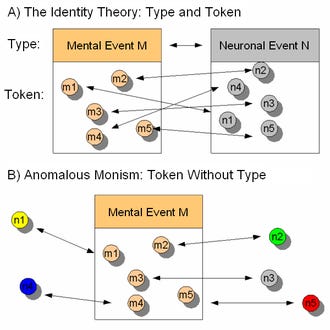
The above diagram is a representation of anomalous monism. Traditional physicalist theories in the philosophy of mind, that is, theories which assert that brain states are identical with mental states, typically assert something to the effect of the upper representation of the diagram. This is known as Type-Identity theory. This theory argues that for every mental event, there is a corresponding physical event of the same type. For example, for every mental state where I hear something, there is a brain (physical) state such that it corresponds to each of those mental states. Thus, they can be said to be of the “hearing” type. But since they’re instantiated differently, we say that there are two tokens of the same type; the mental token, and the physical token. But anomalous monism argues differently. Since there are no strict causal laws that can explain the instantiation of mental states, by definition there cannot be corresponding types of mental and physical states. Instead, there only exist particular instances, or tokens, of mental states.
Although it seems as if anomalous monism seems to betray Davidson’s affinity for a weaker kind of naturalism, which it likely does, I believe there’s a strong argument that the theory is quite consistent with Davidson’s other work. Anomalous monism avoids the charge of conceptual schemes, since mental states are not composed of a different substance (as in Cartesian dualism), and are still physical states, allowing Davidson to claim that they can be readily accessible and directly accessed; but it also allows Davidson to maintain that behaviorism is false despite his insistence on radical interpretability. If behaviorism were true, we would be able to associate behaviors with mental events with little difficulty; but since the mental is anomalous, and there are no fixed laws with with we can operate with in order to understand it like in physics, it is up to us to figure out the states of others and communicate that way. We do use the behaviors of others as a guide to what they believe, what they desire, what they know, etc., but we can only approximate our intimation of those attitudes. There’s always error, but that’s the consequence of how the mind operates. We can never form a fully fleshed out theory of others because our knowledge of the mental will never be complete.
IV. Final Thoughts.
Davidson is one of the most influential philosophers in Anglo-American philosophy, and even one of the most influential in 20th Century philosophy generally. Although he sat firmly within the analytic tradition, he had notable influences on the work of other philosophers from different traditions, such as Hans-Georg Gadamer, Richard Rorty, Jeff Malpas, Charles Taylor, and others. Anyone who is interested in translation, weird theories in the philosophy of mind, or simply a philosopher whose work, despite not having been collected in thick tomes much during his lifetime (having primarily only published journal articles, papers, and conference proceedings), contains some of the most interesting and spectacular conclusions ever to have proceeded from such simple premises, Donald Davidson should come to mind. I am tempted to say about Davidson what Michel Foucault said about Gaston Bachelard:
“[Bachelard] reminds me of skilled chess players who take the biggest pieces with pawns.”
V. Materials
Bibliography
Davidson, D. (1963). Actions, Reasons, and Causes. The Journal of Philosophy, 60(23), pp.685–700. doi:https://doi.org/10.2307/2023177.
Davidson, D. (1973). On the Very Idea of a Conceptual Scheme. Proceedings and Addresses of the American Philosophical Association, 47, pp.5–20. doi:https://doi.org/10.2307/3129898.
Davidson, D. (2001). Mental Events. In: Essays on Actions and Events. Oxford University Press, pp.207–228. doi:https://doi.org/10.1093/0199246270.003.0011.
Kant, I. (2007). Critique of Pure Reason. Translated by M. Weigelt. London: Penguin Books.
Quine, W.V.O. (1951). Main Trends in Recent Philosophy: Two Dogmas of Empiricism. The Philosophical Review, 60(1), pp.20–43. doi:https://doi.org/10.2307/2181906.
Quine, W.V.O. (1960). Word and Object. Cambridge, MA: M.I.T. Press.
Descartes, R., Cottingham, J. and Williams, B. (2017). Meditations on first philosophy: with selections from the Objections and replies. Cambridge, United Kingdom; New York: Cambridge University Press.
Wittgenstein, L., Hacker, P.M.S. and Schulte, J. (2009). Philosophical investigations. Oxford: Wiley-Blackwell.
Further Reading
Stanford Encyclopedia of Philosophy
Davidson: https://plato.stanford.edu/entries/davidson/
Anomalous Monism: https://plato.stanford.edu/entries/anomalous-monism/
Quine: https://plato.stanford.edu/entries/quine/
Internet Encyclopedia of Philosophy
Davidson - Language: https://iep.utm.edu/donald-davidson-language/
Davidson - Mind & Action: https://iep.utm.edu/donald-davidson-mind-action/
Books/Papers
Malpas, J. (2011). Dialogues with Davidson. The MIT Press eBooks. The MIT Press. doi:https://doi.org/10.7551/mitpress/9780262015561.001.0001.
A good book on Davidson’s philosophical relationship with contemporary thinkers from various traditions.
Davidson, D. (1979). The Inscrutability of Reference. The Southwestern Journal of Philosophy, [online] 10(2), pp.7–19. Available at: https://www.jstor.org/stable/43155338.
More on translation and what Davidson thinks of Quine.
Putnam, H. (1983). ‘Two Dogmas’ Revisited. In: Philosophical Papers Vol. 3: Realism and Reason. Cambridge University Press, pp.87–97. doi:https://doi.org/10.1017/cbo9780511625275.007.
Putnam’s argument against Quine’s Two Dogmas.
Just a note: Wittgenstein’s private language argument may also be seen as a precursor to Davidson’s radical interpretation.
Thank youuuuu…. I’ve been waiting ❤️